

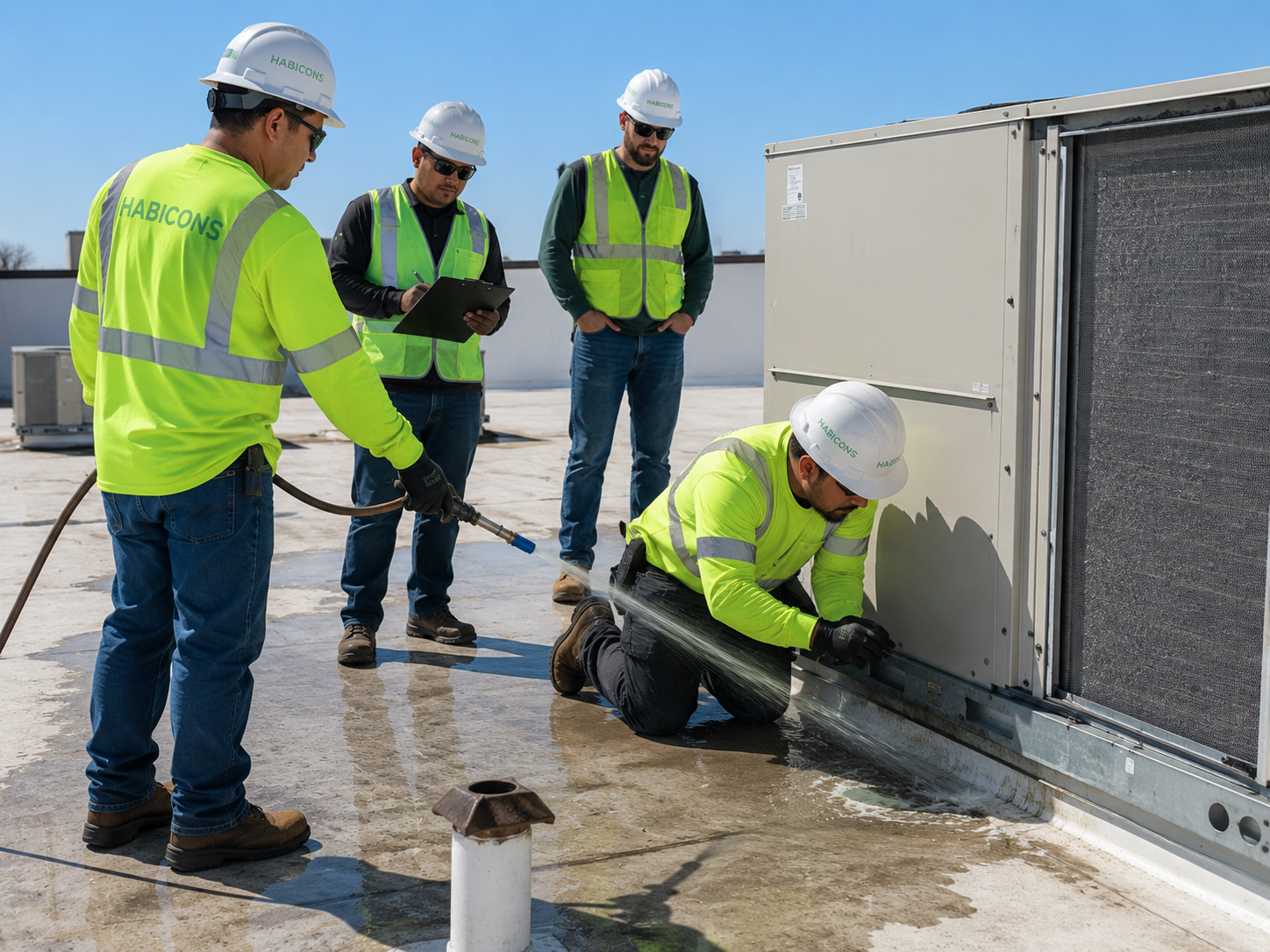
Why Commercial Roof Leaks Happen During Build-Out Projects
In commercial build-out projects such as nail salons, spas, restaurants, offices, and retail spaces, knowing how to fix commercial roof leak issues quickly is important to protect the project schedule and interior finishes. A roof leak can damage ceiling tiles, lighting, electrical equipment, flooring, walls, and finished surfaces. It can also create disputes between the landlord, general contractor, AC team, roofing team, plumbing team, and other trade partners if the real source of the leak is not identified clearly.
As a general contractor, Habicons has handled many roof leak issues during construction. From real project experience, we have learned that roof leak repair should not be based on guesswork. It requires a clear inspection process, proper identification of the root cause, and a clear understanding of responsibility between the building’s existing roof system, roof penetrations, HVAC work, vent systems, and the related trade teams.
Start by Finding the Leak Location Inside the Building
When water is found dripping inside the project area, the first step is to identify the exact leak location below the roof. Do not rush to go onto the roof and repair a random spot, because the location where water appears inside may not be directly below the actual opening above.
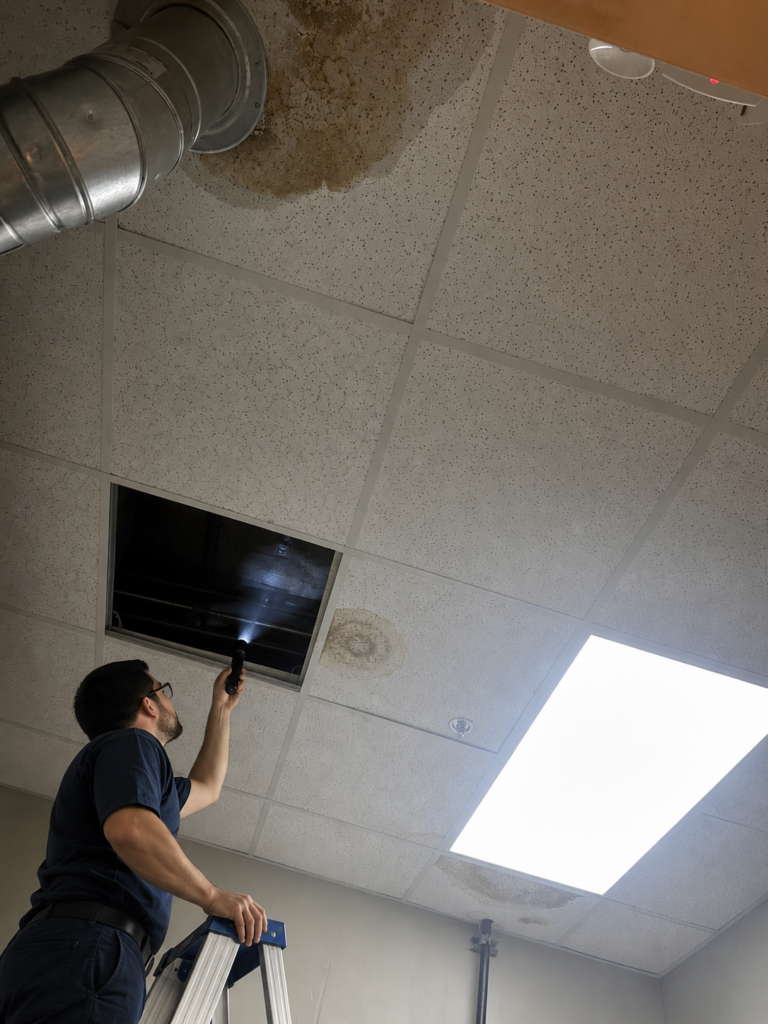
Water can travel along the roof layers, steel framing, pipes, or ceiling system before dripping at a visible point. For this reason, the interior leak location should be marked first. Then, measurements should be taken to trace that location back to the corresponding area on the roof.
Use Water Testing to Confirm the Leak Source
In many cases, the construction team may not be on site at the exact moment it rains. A more practical method is to choose a sunny day and perform a water test. Spraying water helps simulate rain conditions and allows the team to observe whether water continues to enter at the marked interior location.
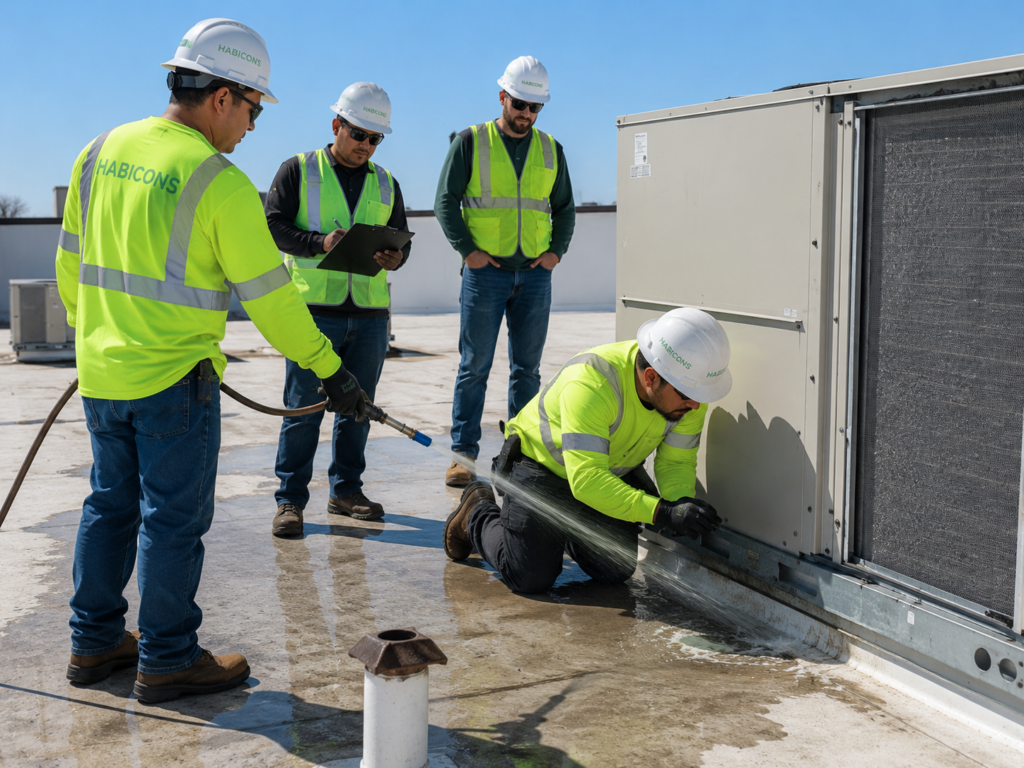
This is an important step. If the location is identified incorrectly, the repair may take more time, cost more money, and still not solve the problem.
Trace the Leak Back to the Roof Area
After identifying the suspected area on the roof, the surrounding area should be inspected carefully. For commercial roofs, especially flat roofs or membrane roofs, even a small hole caused by a nail, screw, metal fragment, or sharp object can create a leak during heavy rain.
The inspection should look for small punctures, tears, cracks, blistered areas, loose membrane, failed previous patches, standing water, and any screws, nails, or construction debris left on the roof.
If a small tear or puncture is found, it may be temporarily repaired with a roof waterproofing sealant tape or other roofing repair product designed to cover small openings. However, this is usually only a temporary solution for minor damage.
If the roof is old, heavily blistered, uneven, or has frequent standing water, the issue may be related to the building’s existing roof system. In that case, the landlord should be notified and involved, because the problem may not be caused by the build-out work alone.
Check Rooftop AC Units, Roof Curbs, Vents, and Roof Penetrations
In commercial build-out projects, the roof is often cut or penetrated to install different mechanical and utility systems. These areas are common leak points if they are not handled properly.
Common roof penetration locations include:
- Rooftop AC units
- Exhaust vent for gas water heaters
- Plumbing vent pipes
- Dryer exhaust vents
- Other utility pipes passing through the roof
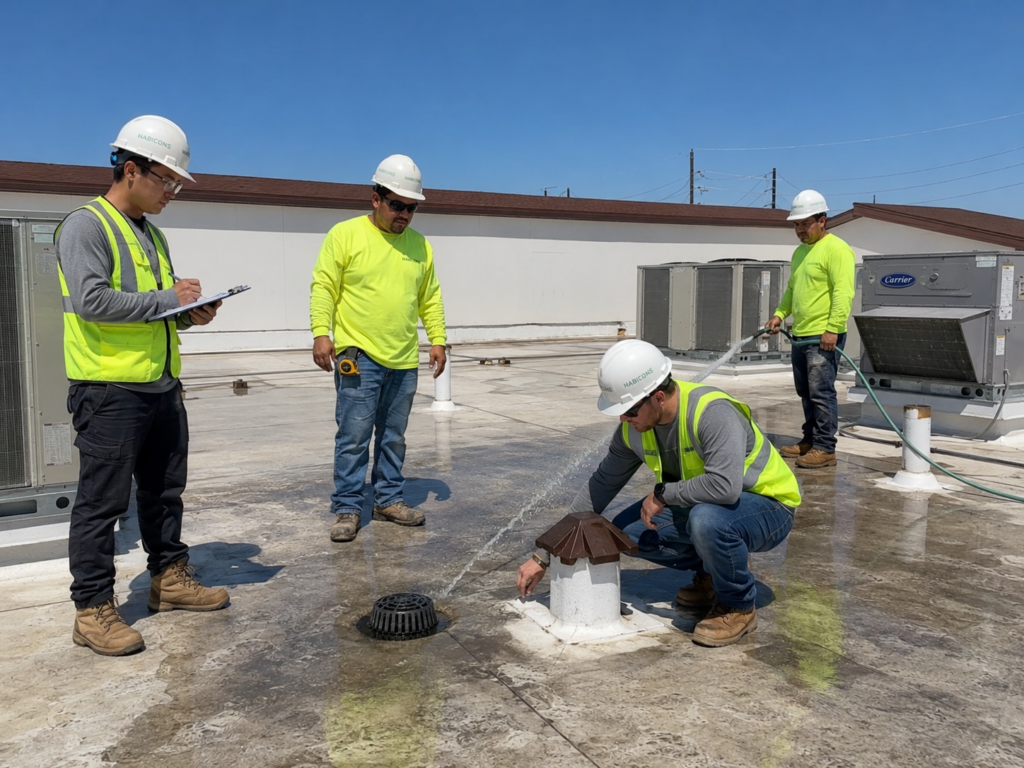
Each roof penetration should be treated as a potential leak point. If the roof cut, roof curb, pipe boot, flashing, vent cap, or sealant is not properly installed, rainwater can enter through very small openings.
For rooftop AC units, two areas should be checked carefully: the connection between the roof and the roof curb, and the connection between the roof curb and the AC unit. If the seal between the roof and the curb is not good, the issue may be related to the roof-cutting team or the flashing work. If the connection between the curb and the AC unit is open, the issue may be related to the HVAC team.
If the HVAC contractor was responsible for cutting the roof, installing the roof curb, and setting the AC unit, then any leak in that area should be reviewed and addressed by that contractor.
For gas water heater exhaust vents, plumbing vents, or dryer exhaust vents, the boot, flashing, collar, and seal around the pipe should be inspected. Simply applying sealant around the pipe is often not enough. Over time, sunlight and rain can cause the material to crack, separate, or fail, allowing water to enter. Gas water heater vents and dryer vents also involve safety and performance concerns, so they must be installed with the correct materials, proper direction, and clear airflow.
Old Roofs, Standing Water, and Blistering Create Higher Risk
Not every commercial roof is in good condition before a build-out begins. Some roofs already have existing problems, but those problems may only become clear during construction or after new equipment is installed.
Warning signs include blistered roof areas, uneven surfaces, lack of proper slope, parapet or edge conditions that hold water, and old membrane material that can tear easily.
On this type of roof, even a small nail hole can cause a leak. When water stays on the roof for a long time, pressure from standing water can make small weaknesses worse. If the roof has proper slope, water drains faster and the risk is lower. But if water ponds on the roof, even a tiny puncture can lead to repeated leaks.
Jobsite experience also shows that nails, screws, metal fragments, and construction debris are common causes of roof punctures. Workers may sometimes leave small materials behind while moving quickly. When other teams walk across the roof or drag materials over those areas, these small items can tear the waterproofing layer. For this reason, the general contractor should remind all trade teams to keep the roof clean, avoid leaving screws or debris behind, and inspect the roof after work is completed.
Suggested Roof Leak Handling Process
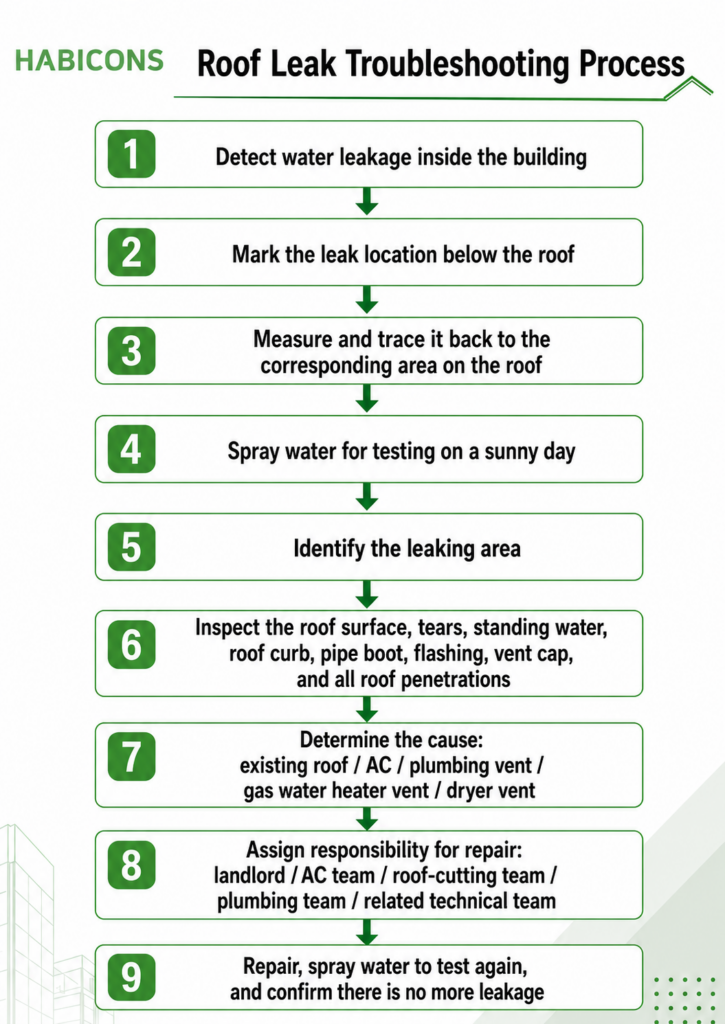
At Habicons, we follow a practical step-by-step process to identify and resolve roof leak issues in commercial build-out projects:
Water leak is found inside the project space
↓
Mark the interior leak location below the roof
↓
Measure and trace the location back to the roof area
↓
Perform a water test on a sunny day
↓
Identify the area where water is entering
↓
Inspect the roof surface, punctures, standing water,
roof curb, pipe boot, flashing, vent cap,
and all roof penetration points
↓
Identify the cause:
existing roof / HVAC / plumbing vent /
gas water heater vent / dryer vent
↓
Determine responsibility:
landlord / HVAC contractor / roof-cutting team /
plumbing team / related trade contractor
↓
Repair the issue, water test again,
and confirm there is no more leak
Practical Advice for Owners and General Contractors
For business owners, it is important to check the roof condition before starting a commercial build-out. If the roof looks old, blistered, uneven, has standing water, or has a history of leaks, this should be discussed clearly with the landlord before investing heavily in the interior build-out.
For general contractors, the roof condition should be documented before construction begins, especially before HVAC, plumbing, electrical, or other trade teams work on the roof. Photos of the existing roof condition are very helpful for separating pre-existing issues from problems caused during construction.
After each roof cut or roof penetration, the area should be inspected immediately. Do not only check from inside the space. The roof should be inspected directly: Is the flashing sealed properly? Is the sealant applied evenly? Is the material suitable for the roof type? Are there any screws, nails, or metal fragments left nearby? Before closing the ceiling or completing interior finishes, it is a good practice to water test all high-risk areas.
Need Help Fixing a Commercial Roof Leak?
Roof leaks in commercial build-out projects are common, but they can be controlled with the right process. The most important thing is not to guess or rush the repair. Start from the interior leak location, trace it back to the roof, perform a water test, review the existing roof condition, and carefully inspect all roof penetration points.
With real experience in commercial projects, Habicons focuses on checking existing conditions, coordinating with trade teams, working with landlords when needed, and finding practical solutions to protect construction quality. When a roof is inspected and repaired properly, it helps the project operate more reliably, reduces future repair risks, and protects the business owner’s investment.
Brian Hoang.